Here’s a fun visual. I would consider this the most important chart in the world right now.
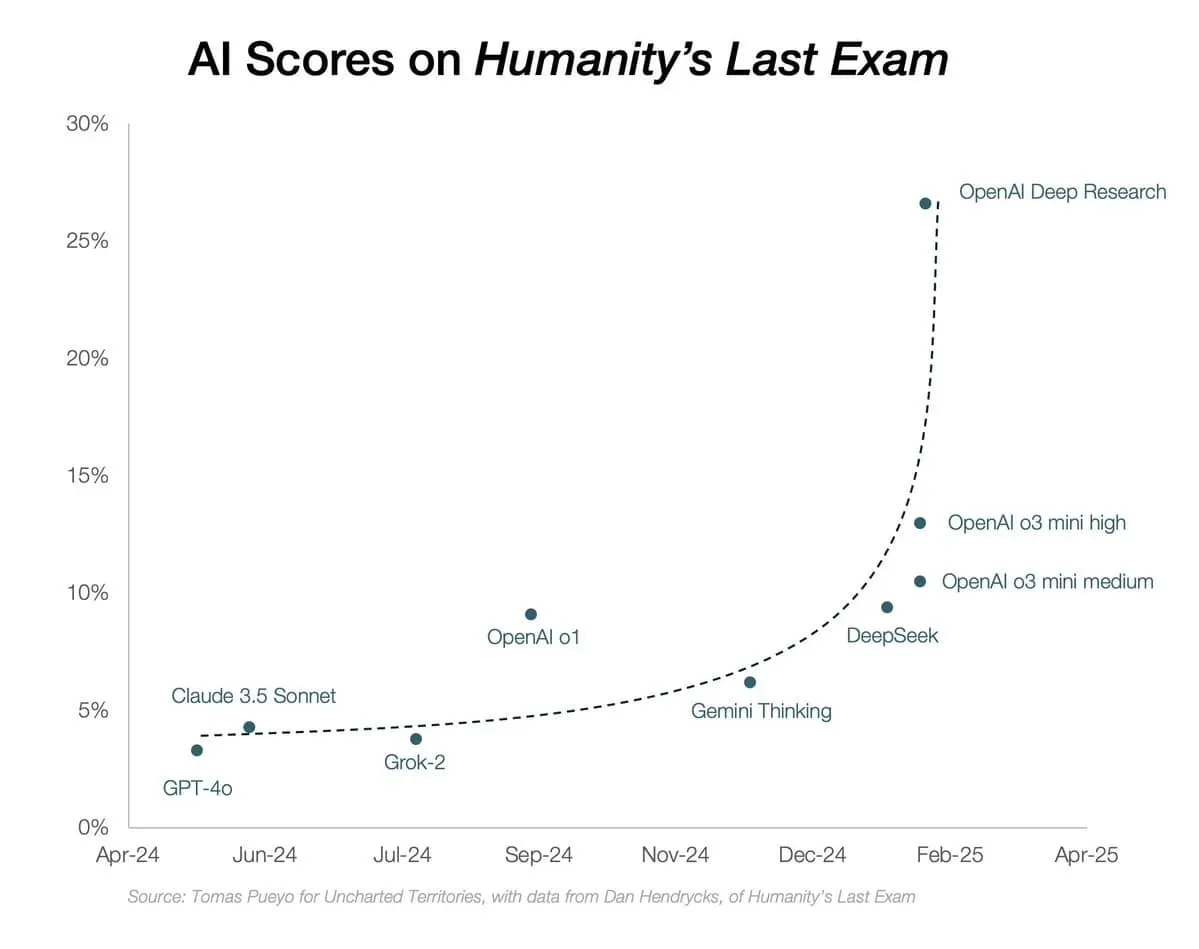
Why? Because this will personally affect every person on the planet and for generations to come.
But first, in order to explain properly, let’s take a quick trip through human history…
Our family tree has had a few major milestones:
Harnessing fire allowed us to cook food, freeing up our digestive energy to grow a bigger brain.
Tossing seeds in the ground and putting fences around animals created free time beyond hunting and gathering. Which led to city-states and human specialization.
Steam, oil, and electricity allowed our ancestors’ workloads to become more productive as machines started doing the heavy lifting.
These innovations all led humans to turn the silica from sand into transistors. Quickly thereafter we got supercomputers and the internet.
Each one of these milestones happened in a quicker timespan. And from an ecological scale, it took only a blink of an eye to go from using fire to solely cook our food to using fire to send rockets into orbit.
Alright, so back to this chart. Why is it so significant?
Ominously named, Humanity’s Last Exam, it’s a 3,000 question test covering nearly every aspect of the world. Its creation was required because AI is already smarter than PhD’s in every human-level benchmark test.
This chart shows how, in just a few months, AI has rapidly improved on a test once deemed nearly impossible, surprising everyone with its speed of progress.
And here we are, standing on the threshold of another massive inflection point. Perhaps bigger and faster than any of its predecessors.
Each time humanity has leveled up… fire, agriculture, industry, transistors… we’ve altered our destiny in ways our ancestors could never have imagined.
This chart may look like a modest curve on a page, but the line represents an accelerating intelligence that’s already outpacing our ability to create new tests fast enough.
What does that mean for us?
It means that the sorts of problems we once considered impossibly complex: genetic research, climate modeling, advanced mathematics, etc. might soon be tackled in hours or minutes rather than years.
It means rethinking jobs, ethics, education, governance, and even what we consider “uniquely human.” Because if a machine can outscore PhDs on the hardest exam we can dream up, then knowledge work is on the cusp of being redefined.
More importantly, these models don’t stop. Each data point on the chart is not just a single milestone; it’s a harbinger that the next breakthrough could happen even faster.
The pace of progress is compounding, and no sector of society will remain untouched. If history has taught us anything, it’s that exponential leaps in capability come with equally exponential consequences.
Are we prepared for the kind of shift that might happen in just a few short years?
Think about the next generation, the one after that, and the world they’ll inherit.
Will they look back on this chart as the moment we embraced an incredible ally, or unleashed something most people never attempted to understand?
One thing is certain: we’ve never been here before, and we’re not slowing down.
The only question is whether we can adapt as quickly as the technology does… and what will this all mean for the future of our human story?